Motherwort Materia Medica
Société Apothecary
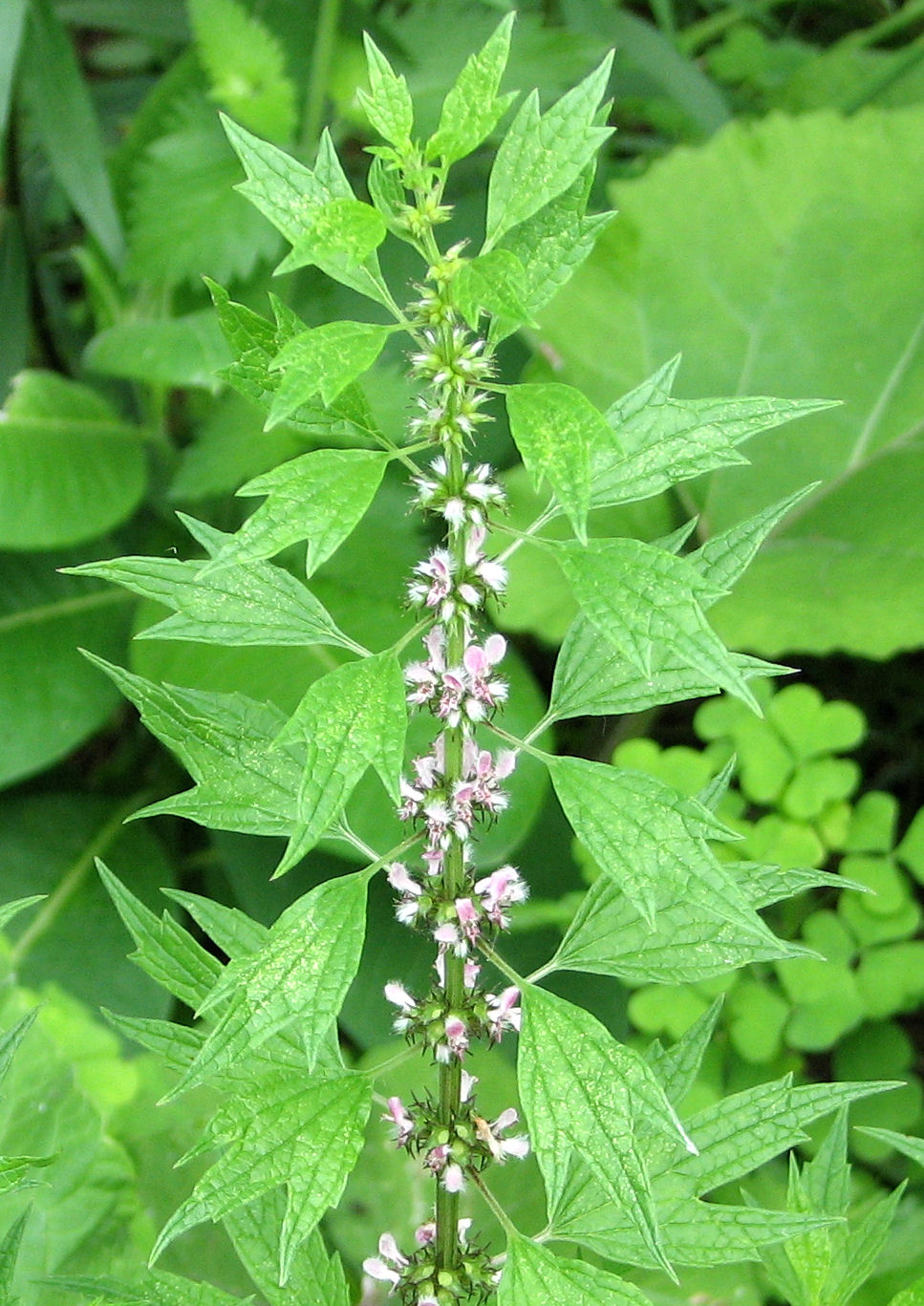
SUMMARY Motherwort is the plant world’s mama bear. Or mama lion, from its Latin name Leonurus cardiaca , which translates to the Lion-Hearted One. It represents the archetype of the feminine - the Mother. Motherwort has affinities for the digestive, nervous, cardiovascular, and female repreductive systems. MATERIA MEDICA Latin Binomial: Leonurus cardiaca Common Name(s) : Motherwort, Lion'sTail, Throw Wort TCM Name : Yi Mu Cao Ayurvedic Name : Khandbahale Family: L amiaceae (mint family) Physical Description of the Plant: Motherwort is an upright herbaceous perennial with a height of up to 5 feet. with square stems with short hairs. The opposite leaves are dark green above, pale below, oak-shaped and deeply lobed into three, with serrated margins. The flowers are pale pink to purple with three lobed bracts, appearing in leaf acils on the upper part of the plant in whorls of 6 to 12, alternating up the stems with leaves and very prickly. Bloom begins in late June in temperate zones. Habitat: Motherwort is probably native to the southeastern part of Europe and central Asia where it has been cultivated since ancient times. Harvest and Collection: The aerial parts are gathered when in flower. Parts of the Plant Used: Leaves and flowers (Seed, Chong Wei Zi used in TCM.) Qualities: deeply calming to the nerves, a bitter and pungent digestive-stimulant, a relaxing nervine, an antispasmodic and emmenagogue for the reproductive system, and a tonic for the cardiovascular system. Chemical Constituents: Alkaloids (stachydrine, leonurinine) Aroline-betaines (stachydrine, betonicide) Iridoids (ajugoside = leonuride) Glycosides (leonurine, leonuridin) Flavonoids (chiefly flavonols; also methoxy-flavones; genkwanin) Diterpenes (leocardin) Triterpenes (ursolic acid) Caffeic acid Phenolic acids (Caffeic acid derivatives) Phenylethanoid glycosides (verbascoside = acteoside) Tannins vitamin A Taste: Acrid, Very Bitter Actions (Western): Antispasmodic Astringent Bitter tonic Cardiac tonic Cardiovascular trophorestorative Emmenagogue Nervine relaxant Nervine sedative Relaxant diaphoretic Uterine tonic Vasodilator Key TCM Actions & Medicinal Uses: Invigorate Blood and Regulate Menses Reduce masses caused by blood stasis Promote Urination and Reduce Swelling Seeds slightly sweet and cold, break up blood and are more astringent and tonifying Cools Liver and Brightens Eyes Premier herb for strengthening the heart and promoting longevity. Meridians : Heart, Pericardium, Liver, Bladder Indications: PMS and cramping, lack of menses (amenorrhea), nervousness, anxiety, heart palpitations, hyperthyroidism, menopausal symptoms, liver stagnation. Contraindications/Cautions: Not recommended during pregnancy due to its emmenagogue action. Drug Interactions: Motherwort lowers blood pressure slightly so it may interact with blood pressure medications. Because of its nervine effects, it may also synergize with anxiolytic or opiate based pain medications. Dosage: Tincture : (extracted fresh in 60% alcohol) take ½ to 1 teaspoon up to twice a day. Infusion : use 1-2 teaspoons of dried herb per cup of boiling water. Steep 10 minutes. Drink up to 2 cups a day. Because of the very bitter taste, add honey or other sweetener. Combinations: as a heart tonic can be combined with hawthorn and linden, for hotflashes combined with blue vervain and black cohosh, for fevers combined with boneset, yarrow, or blue vervain. Energetics: Cooling, drying Folklore: In ancient China, motherwort was reputed to promote longevity. In Europe, Motherwort first became known as a treatment for cattle diseases. Colonists introduced Motherwort into North America and the 19 th century Eclectics recommended it as a menstruation promoter and aid to expelling the afterbirth. Ritual Uses: herb of Venus and Leo. It is a strengthening herb, giving a person a sense of purpose, and joy in the completion of the work needed. t is also used as an herb of protection and countermagicke. Flower Essence: Motherwort - I AM the wisdom of the grandmothers. Motherwort helps us know the wisdom and power of womanhood. Applications: Anxiety with heart involvement; irregular menses; digestive issues brought on by stress. RECIPES Cool as a Cucumber Tea 1 oz motherwort 2 oz linden flower 1 oz chamomile flower 4 oz skullcap herb 3 oz borage flowers, stems, and leaves 2 oz marshmallow root 2 oz hibiscus flower Combine 1 oz of the mixture with 4 cups of boiling water in a teapot or container with a well-fitting lid. Let stand for fifteen minutes; then strain the tea and store it in a closed container. Allow to cool; drink at room temperature. Nervous GI Formula Motherwort (Leonurus cardiaca) 20% Hops (Humulus lupulus) 20% Chamomile (Matricaria recutita) 20% Catnip (Nepeta cataria) 20% Valerian (Valeriana officinalis) 20% Hyperthyroid Formula Motherwort (Leonurus cardiaca) 33% Bugleweed (Lycopus virginicus) 33% Lemon Balm (Melissa officinalis) 33% Menopause/Hot Flash Formula Motherwort (Leonurus cardiaca) 33% Black Cohosh (Cimicifuga racemosa) 33% Blue Vervain (Verbena hastata) 33% SCIENTIFIC RESEARCH Phytochemistry. 2018 Mar;147:167-183. doi: 10.1016/j.phytochem.2017.12.016. Epub 2018 Jan 12. Phytochemistry and pharmacology of the genus Leonurus: The herb to benefit the mothers and more. Zhang RH 1, Liu ZK 2, Yang DS 2, Zhang XJ 1, Sun HD 2, Xiao WL 3. Abstract Plants belonging to the genus Leonurus, also named Motherwort, are traditionally used for anti-gynecological disorder in East Asia, and for sedative in Europe. Chemical investigation of the genus Leonurus not only enriched the natural products library, but also enlarged the pharmacological application of this traditional herb. In this review, we systematically summarized the structures of 259 compounds isolated from the genus Leonurus, featured with 147 labdane diterpenoids. The reported bioactivity studies up to 2017 are presented in the second part, with the main focus on the isolated compounds and also concerning the extracts. In addition to the traditional uterine contraction and sedative activity, recently the cardiovascular protection effect of leonurine has drawn most attention. Other than that, neuroprotection, anti-inflammation, anti-cancer, anti-platelet aggregation and many other activities have been assigned to various compounds from the genus Leonurus. Among 70 bioactivity references cited in this review, 57% of them were concentrated on two alkaloids (leonurine and stachydrine), whereas only 20% are about the 147 diterpenoids. Anti-inflammation is the major bioactivity discovered so far for the labdane diterpenoids from the genus Leonurus, whose further therapeutic potential still remains for exploration. KEYWORDS: Anti-gynecological disorder; Anti-inflammation; Cardiovascular protection; Labdane diterpenoids; Lamiaceae; Leonurine; Leonurus; Traditional Chinese medicine 10.1016/j.phytochem.2017.12.016 Phytother Res. 2013 Aug;27(8):1115-20. doi: 10.1002/ptr.4850. Epub 2012 Oct 8. Leonurus cardiaca L. (motherwort): a review of its phytochemistry and pharmacology. Wojtyniak K 1, Szymański M , Matławska I . Abstract Leonurus cardiaca is a perennial plant indigenous to central Europe and Scandinavia, but it is also found in the area spanning temperate Russia to central Asia. It has been introduced to North America and has become established locally in the wild. Motherwort (Leonuri cardiacae herba) consists of aerial parts of Leonurus cardiaca gathered during the flowering period, dried at 35 °C and, according to European Pharmacopoeia 7th edition, should contain a minimum of 0.2% flavonoids, expressed as hyperoside. Compounds belonging to the group of monoterpenes, diterpenes, triterpenes, nitrogen- containing compounds, phenylpropanoids, flavonoids and phenolic acids, as well as volatile oils, sterols and tannins, have been identified in motherwort. Traditionally, extracts of the herb have been used internally, mainly for nervous heart conditions and digestive disorders. However, they have also been used for bronchial asthma, climacteric symptoms and amenorrhoea, as well as externally in wounds and skin inflammations. Mild negative chronotropic, hypotonic and sedative effects can be attributed to the herb and preparations thereof. Pharmacological studies have confirmed its antibacterial, antioxidant, anti-inflammatory and analgesic activity, as well as its effects on the heart and the circulatory system. Sedative and hypotensive activity has been demonstrated in clinical trials. KEYWORDS: Leonurus cardiaca L; motherwort; pharmacology; phytochemistry Chinese studies indicate that the active chemical components are at their highest concentrations when the plant is in bloom. References: https://www.whiterabbitinstituteofhealing.com/herbs/motherwort/ http://www.susunweed.com/Article\_Motherwort.htm https://theherbalacademy.com/motherwort-the-plant-worlds-mama-bear/ https://objects-us-west-1.dream.io/evolutionaryherbalism.com/wp-content/uploads/2017/09/Motherwort-Leonurus-cardiaca.pdf Three Motherwort Recipes to Try at Home Soothing Motherwort Tea 1 tablespoon dried motherwort leaves 1 cup boiling water Honey or lemon (optional) Place the dried motherwort leaves in a teapot or heatproof cup. Pour boiling water over the leaves, covering them completely. Allow the tea to steep for 10-15 minutes, then strain. Sweeten with honey or add a splash of lemon if desired. Sip slowly and enjoy the calming effects. Heartwarming Motherwort Tincture 1 cup dried motherwort leaves 2 cups high-proof vodka or brandy Glass jar with a tight-fitting lid Fill the glass jar with dried motherwort leaves, leaving about an inch of space at the top. Pour vodka or brandy over the leaves until they are completely submerged. Seal the jar tightly and store it in a cool, dark place for 4-6 weeks, shaking it gently every few days. Strain the tincture through a fine mesh sieve or cheesecloth into a clean bottle. Use 1-2 droppers full, diluted in water, as needed to support heart health. Motherwort-Infused Bath Salts 1 cup Epsom salt 1/2 cup dried motherwort leaves 10 drops lavender essential oil In a mixing bowl, combine Epsom salt with dried motherwort leaves. Add lavender essential oil, stirring well to distribute evenly. Store the mixture in an airtight container. Add 1/2 cup of the bath salts to warm bathwater, stirring to dissolve. Soak and unwind for at least 20 minutes, embracing the nurturing energy. As with any herbal remedy, it's best to consult a qualified practitioner before use.