Lady's Mantle: Materia Medica
Société Apothecary
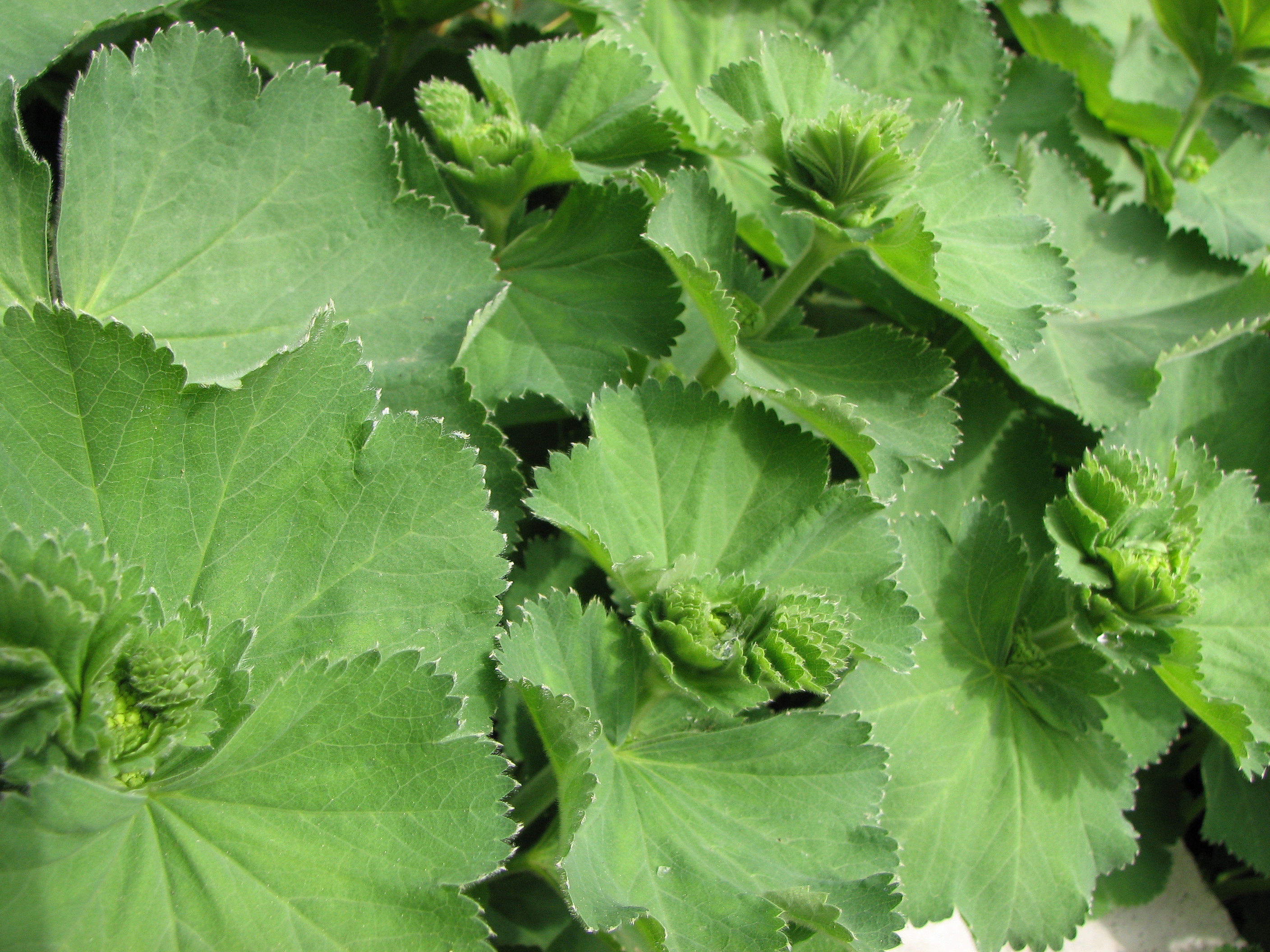
SUMMARY Reminiscent of the virgin’s cloak in medieval paintings, the leaves with scalloped edges are reputed to have given Lady’s Mantle its name. Like many herbs with ‘lady’ or ‘mother’ as part of their common name, it is a valuable gynaecological herb, specifically for heavy menstrual bleeding and vaginal itching. Highly astringent and rich in tannins, it was one of the most popular wound herbs on the battlefields of 15th & 16th centuries. Lady’s Mantle leaves are ‘waterproof’ – beads of dew/rain gather. MATERIA MEDICA Latin Binomial: Alchemilla vulgaris, Alchemilla mollis Common Name(s) : Lady’s Mantle, Lion's Foot. Bear's Foot. Nine Hooks. Leontopodium. Stellaria TCM Name : Nu Shi Di Yi Bo Family: Rosaceae Physical Description of the Plant: The rootstock is perennial black, stout and short - and from it rises the slender erect stem. The whole plant is clothed with soft hairs. The lower, radical leaves, large and handsome, 6 to 8 inches in diameter, are borne on slender stalks, 6 to 18 inches long and are somewhat kidney shaped in general outline, with their margins cut into seven or mostly nine broad, but shallow lobes, finely toothed at the edges, from which it has obtained one of its local names: 'Nine Hooks.' The upper leaves are similar and either stalkless, or on quite short foots talks and are all actually notched and toothed. A noticeable feature is the leaf like stipules, also toothed, which embrace the stem. The flowers, which are in bloom from June to August, are numerous and small, only about 1/8 inch in diameter, yellow-green in colour, in loose, divided clusters at the end of the freely-branching flower-stems, each on a short stalk, or pedicle. There are no petals, the calyx is four-cleft, with four conspicuous little bracteoles that have the appearance of outer and alternate segments of the calyx. There are four stamens, inserted on the mouth of the calyx, their filaments jointed. Habitat: Lady’s Mantle is native to Europe and northern Asia. It prefers of pasture, damp places and shady woods. Harvest and Collection: The leaves and stems are collected between mid-summer and late summer. Parts of the Plant Used: Leaves and flowering shoots (aerial parts). Qualities: Cool, dry, bitter & astringent to taste (Ody). Hot & dry in the 2nd degree Chemical Constituents: Flavonoids Ellagitannins (pedunculagin, agrimoniin, and alchemillin) Salicylic Acid Saponins Phytosterols Volatile oil Bitter Principles Taste: The leaves of the Lady's Mantle are edible, but not very tasty. You can use the young leaves in salads and much in the same way you would use spinach. As the leaves grow older they have an even more bitter taste. It is not common to use Lady's Mantle as a culinary herb. Flower Essence: Brings gentle joyful peace to your emotional heart and your whole body. Calms emotional shock to the heart, by inviting the Divine to encircle the heart and corresponding levels of the electromagnetic system. Encourages self-love and compassion for others. Actions: Uterine astringent Uterine tonic Nervine –anti-anxiety Astringent Anti-inflammatory Progestogenic Dry up & expel water from tissues Haemostatic Emmenagogue Vulnerary Febrifuge Indications: Menorrhagia esp adolescence & peri-menopause – reduce pain. Peri-menopause – reduce flushing and vaginal irritation DUB – reduce excessive flow while also toning. Prolapse Fertility promotion – improve uterine tone and cell membrane integrity Insomnia Diarrhoea – BHP specific for acute diarrhoea and epidemic diarrhoea of infants Rashes Anxiety Haemorrhoids Abdominal hernia After birth — tonic to tonify and strengthen tissue Wounds with discharge – drying, cleansing and strengthening to tissues – Strengthens the tissue integrity. Damage to nerves and tendons — eases pain, reduces inflammation & heals Topically – Leucorrhoea Contraindications/Cautions: Theoretical caution with anticoagulants – but no pro-thrombotic effects reported Tannins – may inhibit mineral supplement absorption Seek professional advice for any sudden or abnormal change in uterine bleeding AVOID USE IN PREGNANCY (except in the last few weeks): As this herb is a uterine stimulant Drug Interactions: None Dosage: 2-4ml TDS of a 1:2 25-30 per week Drop Dose: 20 – 40 drops t.d.s. Applications: Infusion: Use for gastroenteritis or diarrhea – take up to five times daily for acute Sx Tincture: Use for period pain, menstrual irregularities & menopausal problems Ointment: Used to relieve vaginal itching – combine 50 g ointment base with approx. 20ml rosewater and 15ml of infusion/tincture anduse morning & night Wash: Use infusion externally for eczema that weeps or weeping sores Mouthwash/Gargle: Use infusion for sore throats, laryngitis & mouth ulcers Douche: Use infusion for vaginal discharges/itching Pessaries: Combine 20 drops tincture with 20g cocoa butter to make 12-16 pessaries Combinations: Yarrow for regulating menses in young girls Look at other herbs to TREAT THE CAUSES of heavy bleeding – e.g. phytolacca, sarsaparilla & pulsatilla Energetics: Women who crave subtle balance, poise & integrity – wishes to uplift those around her. Someone who needs protection but feels the need to do good in the world. She needs to bloom to be happy but yet be protected from masculine energy that tries to keep her in a tight bud. Folklore: The Latin Name “Achemilla” stems from alchemy. It was believed by many alchemists that the dew drops on the Lady’s Mantle were a vital ingredient in the production of gold. During the Middle Ages in Europe it was said that drops of dew from the Lady’s Mantle were marvelous to treat illness in the eyes. This would have a positive effect if the dew used as eye drops was retrieved directly from the leaves. During the Middle Ages this herb played an important part in the lives of many women. In England they used to call it “a woman’s best friend”. Women would drink tea made from the green leaves of the Lady’s Mantle for 10 days in a row each month. This was supposed to reduce the discomforts of menopause. In Europe Lady’s Mantle was also recommended for young women who had recently given birth. They would cover their breasts with leaves from Lady’s Mantle believing this would retrieve the lovely firm breasts they had before pregnancy. During the Middle Ages there was a superstition concerning women and how to maintain their youth. If a woman wished to keep her sweet youthful appearance she had to go collect the dew drops found on the Lady’s Mantle during the month of May. This would only work if she did it in the nude and alone. RECIPES WOMB TEA This simple tea tones the pelvic region and is highly recommended for womb health. It can be used in conjunction with uterine massage. Ingredients 2 parts nettle 2 parts white oak bark 1 part lady’s mantle 1 part oats 1 part raspberry leaf Spearmint or peppermint (optional; for flavour) Method Boil 1 quart of water per ounce of herb (or one cup of water to 1 tablespoon of herb). Pour water over the herbs and let steep for 30 to 60 minutes. The more herb you use and the longer you let it steep, the stronger the brew. Drink two to three cups daily. BREAST HEALTH TEA This mineral-rich tea nourishes the blood and encourages healthy lymphatic flow. Ingredients 2 parts calendula 2 parts red clover 1 part cleavers 1 part lady’s mantle Spearmint or peppermint (optional; for flavour) Method Boil 1 quart of water per ounce of herb (or one cup of water to 1 tablespoon of herb). Pour water over the herbs and let steep overnight. The more herb you use and the longer you let it steep, the stronger the brew. Drink two to three cups daily. HAPPY UTERUS TEA This tea is intended to alleviate menstrual cramps. You can also use this tea at the very end of pregnancy to prepare your uterus for labor and prevent hemorrhage. Ingredients 1/2 cup Lady’s Mantle 1/2 cup Red Raspberry Leaf 1/4 cup Lemon Balm (you can add more to taste) Method Put these in a pint-size Mason jar with a lid and shake until they’re mixed up well. To make this tea, steep a tablespoon of herbs in a cup of hot water for about 5 minutes. Begin drinking the tea about a week before I’m expecting my period. If you have problems with heavy cramping, try drinking a cup (warm or iced) every day of the month. SCIENTIFIC RESEARCH References: Bone, K. (2003). A Clinical Guide to Blending Liquid Herbs: Herbal Formulations for the Individual Patient. St Louis, Missouri: Elsevier Hoffman, D. (1996). The Complete Illustrated Holistic Herbal. Element Books LTD. Fetrow, Charles & Juan Avila (2000). The Complete Guide to Herbal Medicines. New York, NY: Pocket Books. Ody, Penelope (1993). The Complete Medicinal Herbal. New York, New York: Dorling Kindersley. Gladstar, Rosemary (2012). Medicinal Herbs. A beginner's guide. North Adams, MA: Storey Publishing. McIntyre, Anne (2010). The Complete Herbal Tutor. London, England: Hatchet Company. Gladstar, Rosemary (2001, 2008). Herbal Recipes for Vibrant Health. North Adams, MA: Storey Publishing. http://www.luontoportti.com/suomi/en/kukkakasvit/ladys-mantles https://www.indianmirror.com/ayurveda/lady-mantle.html https://botanical.com/botanical/mgmh/l/ladman05.html https://usesofherbs.com/ladys-mantle https://www.treefrogfarm.com/store/flower-essences-tree-essences/lady-s-mantle-flower-essence.html https://materiamedicaresource.wordpress.com/2013/08/11/ladies-mantle/