Damiana: Materia Medica
Société Apothecary
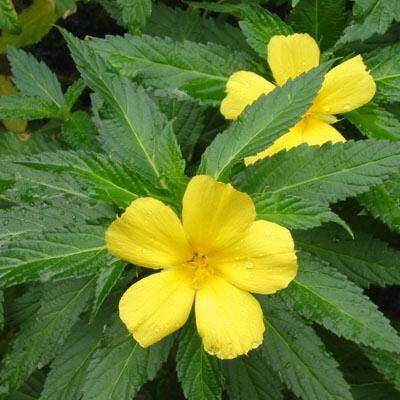
\ \ Damiana Materia Medica]( https://www.societeapothecary.com/s/search?q=damiana ) SUMMARY Damiana has an ancient reputation going all the way back to the Mayans. Historically, Damiana has been used to relieve anxiety, nervousness, and mild depression, especially if these symptoms have a sexual component. The herb is also used as a general tonic to improve wellness. MATERIA MEDICA Latin Binomial: Turnera diffusa Common Name(s) : Damiana, Mexican Damiana TCM Name : n/a Ayurvedic Name(s) : n/a Family: Passifloraceae Physical Description of the Plant: Damiana is a small woody shrub with smooth, pale green, serrated, wedge-shaped leaves arranged alternately on a short, slender leaf stalk, and small, 5-petaled aromatic yellow flowers that grow in the leaf axils. It blossoms in early to late summer and is followed by small fruits that taste similar to figs. The shrub is said to have a strong spice-like odor somewhat like chamomile. Habitat: Native to southern Texas in the United States, Central America, Mexico, South America, and the Caribbean. Harvest and Collection: The leaves and stems of the damiana plant are gathered when in bloom. Parts of the Plant Used: Dried leaves and stems. Qualities: Damiana invigorates the brain and nerves, regulates the pituitary gland, and promotes physical endurance. The bitter principle stimulates the nerves and genitals and allows nerve messages to more readily spread throughout the body. Energetics: Warm, dry, yang nourishing Taste : slightly bitter, aromatic, pungent Chemical Constituents: In total, 22 flavonoids, maltol glucoside, phenolics, seven cyanogenic glycosides, monoterpenoids, sesquiterpenoids, triterpenoids, polyterpene ficaprenol-11, fatty acids, and caffeine 1,8-cineole acacetin apigenin α-pinene arbutin β-carotene β-pinene β-sitosterol damianin gonzalitosin I hexacosanol p-cymene tannins tetraphyllin B thymol tricosan-2-one Actions: Western: Anti-catarrhal Antidepressant / Thymoleptic Anti-inflammatory Anxiolytic Aphrodisiac Astringent Balances hormones Bitter Increases stramina Mild diuretic Mild laxative Nervine tonic Reproductive tonic Stimulant Testosteromimetic Eastern: Kidney Yang tonic Meridians: Kidney Indications: Anxiety Debility Depression Erectile dysfunction Impotence Infertility Low libido Nervous dyspepsia Neuralgia Contraindications/Cautions: Damiana is generally considered safe, but avoid using it during pregnancy and in cases of urinary tract infections. Long-term use may interfere with absorption of iron. Drug Interactions: None reported, however, it might potentiate antidiabetic medications. Dosage: Tincture : 1 tsp per day Infusion: 1 tsp damiana in 1 cup boiling water, steep 10-15 min, take 3x per day. Combinations: Combine withAvena sativa (milky oats) for nervous system debility and depression. Can also be combined with Ginseng and Shatavari. Folklore: Damiana leaves have been used as an aphrodisiac and to boost sexual potency by the native peoples of Mexico, including the Mayan Indians. A Spanish missionary first reported that the Mexican Indians made a drink from the leaves, added sugar, and drank it for its purported power to enhance lovemaking. Damiana has a long history of use in traditional herbal medicine throughout the world. It is thought to act as an aphrodisiac, antidepressant, tonic, diuretic, cough-suppressant, and mild laxative. It has been used for such conditions as depression, anxiety, sexual inadequacy, debilitation, bed-wetting, menstrual irregularities, gastric ulcers, and constipation. In Mexico, the plant also is used for asthma, bronchitis, neurosis, diabetes, dysentery, dyspepsia, headaches, paralysis, nephrosis, spermatorrhea, stomachache, and syphilis. Damiana first was recorded with aphrodisiac effects in scientific literature over 100 years ago. From 1888 to 1947 damiana leaf and damiana elixirs were listed in the National Formulary in the United States. For more than a century damiana's use has been associated with improving sexual function in both males and females. Damiana was included in several 19th-century patent medicines, such as Pemberton's French Wine Coca. The leaves were omitted from that product's non-alcoholic counterpart, Coca-Cola. Flower Essence: When we feel inadequate, weak, emotionally needy or detached from the flow of vital life force, Damiana relaxes and restores our radiant fullness of energy and sensuality. Sensuality is not about sex, but about receiving information from your five senses. If you were shamed as a child for your sensual explorations, Damiana flower essence can heal and transform those feelings. Applications: For increased energy, asthma, depression, impotence and menstrual problems. Dr. James Balch reports in his book Prescription for Nutritional Healing that damiana "relieves headaches, controls bed-wetting, and stimulates muscular contractions of the intestinal tract. . . ." The leaves are used in Germany to relieve excess mental activity and nervous debility, and as a tonic for the hormonal and central nervous systems. E. F. Steinmetz states that in Holland, damiana is renowned for its sexual-enhancing qualities and its positive effects on the reproductive organs. The British Herbal Pharmacopoeia cites indications for the use of damiana for "anxiety neurosis with a predominant sexual factor, depression, nervous dyspepsia, atonic constipation, and coital inadequacy." Recipes: Damiana Liqueur (Rosemary Gladstar) Ingredients 1 ounce damiana leaves 2 cups vodka 1 ½ cup spring water 1 cup honey dash of rose water (optional) dash of vanilla extract (optional) Directions Soak the damiana leaves in the vodka for 5 days. Strain the leaves through cheesecloth, squeezing out as much of the liquid as possible. Reserve this alcohol extract and soak the strained leaves in the spring water for 3 days. Strain again through a cheesecloth, and again, squeeze out as much of the liquid as possible. In a small pot over low heat, warm this water extract and add the honey until the honey is completely dissolved. Remove from heat, combine with the alcohol extract, rose water and vanilla extract and store in a clean, airtight container for 1-2 months. Scientific Research: Ethnobotany, phytochemistry, and bioactivity of the genus Turnera (Passifloraceae) with a focus on damiana--Turnera diffusa. Szewczyk K, et al. J Ethnopharmacol. 2014. Abstract ETHNOPHARMACOLOGICAL RELEVANCE: Half a dozen of the currently accepted 135 Turnera species are used in traditional medicine, most notably Turnera diffusa Willd. ex Schult. which is one of the most highly appreciated plant aphrodisiacs. Other traditional uses of Turnera L. species include the treatment of anaemia, bronchitis, cough, diabetes, fever, fungal disease, gastrointestinal complaints, pain, pulmonary and respiratory diseases, skin disorders, and women׳s health problems. Additionally, Turnera species are used as abortives, expectorants, and laxatives. PHYTOCHEMISTRY: Flavonoids (22 different compounds), maltol glucoside, phenolics, cyanogenic glycosides (7 different compounds), monoterpenoids, sesquiterpenoids, triterpenoids, the polyterpene ficaprenol-11, fatty acids, and caffeine have been found in the genus Turnera. BIOACTIVITY: Bioactivities experimentally proven for members of the genus Turnera encompass antianxiety, antiaromatase, antibacterial including antimycobacterial, antidiabetic, antioxidant, adapatogenic, antiobesity, antispasmodic, cytotoxic, gastroprotective, hepatoprotective, and aphrodisiac activities. Most of these activities have so far been investigated only in chemical, cell based, or animal assays. In contrast, the antiobesity activity was also investigated in a study on healthy human subjects and with a herbal preparation containing among other ingredients Turnera diffusa leaves. Moreover, the enhancement of female sexual function was assessed in humans; again the product contained besides Turnera diffusa other potentially bioactive ingredients. However, with only few exceptions, most of the traditional uses and the experimentally verified bioactivities can currently not be related to a particular compound or compound class. A notable exception is the flavonoid apigenin, which was identified animal experiments as the antinociceptive principle of Turnera diffusa. CONCLUSION: In this review, the current knowledge on ethnobotanical uses of members of the genus Turnera, the secondary metabolites reported from Turnera, and experimentally documented bioactivities from Turnera extracts and pure compounds derived from Turnera extracts are compiled. Moreover, some of the most interesting avenues for future research projects are being discussed briefly. These include in particular the aphrodisiac activity of Turnera diffusa and the antibiotic activity potentiating effect of Turnera ulmifolia L. against aminoglycoside resistant bacteria. Phytochemical investigation of Turnera diffusa. Zhao J, et al. J Nat Prod. 2007. Abstract A phytochemical investigation of Turnera diffusa afforded 35 compounds, comprised of flavonoids, terpenoids, saccharides, phenolics, and cyanogenic derivatives, including five new compounds (1-5) and a new natural product (6). These compounds were characterized as luteolin 8-C-E-propenoic acid (1), luteolin 8-C-beta-[6-deoxy-2-O-(alpha-l-rhamnopyranosyl)-xylo-hexopyranos-3-uloside] (2), apigenin 7-O-(6' '-O-p-Z-coumaroyl-beta-d-glucopyranoside) (3), apigenin 7-O-(4' '-O-p-Z-coumaroylglucoside) (4), syringetin 3-O-[beta-d-glucopyranosyl-(1-->6)-beta-d-glucopyranoside] (5), and laricitin 3-O-[beta-d-glucopyranosyl-(1-->6)-beta-d-glucopyranoside] (6). Their structures were determined by spectroscopic and chemical methods. References: https://www.goldenpoppyherbs.com/blog/damiana-materia-medica/ https://materiamedicaresource.wordpress.com/2013/08/08/damiana/ http://indianayurvedaonline.blogspot.com/2010/09/damiana-turnera-aphrodisiaca.html https://www.ncbi.nlm.nih.gov/m/pubmed/24468305/?i=6&from=/28237475/related https://www.ncbi.nlm.nih.gov/m/pubmed/17284070/?i=66&from=Turnera%20diffusa http://www.rain-tree.com/damiana.htm#.W6QAlM5KjIU https://www.desert-alchemy.com/flower-essence/dami/ https://www.desert-alchemy.com/article/regeneration/ https://www.damiana.net/